The Heat Loss of a Room calculator estimates the heat loss in a room based on the surface area of the interior of a rectangular room including the walls and ceiling, the temperature variance (inside and outside) and a coefficient of heat transfer.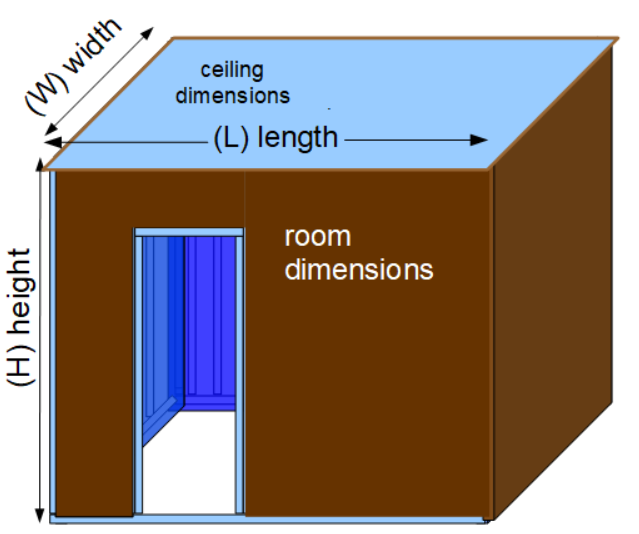
INSTRUCTIONS: Choose units and enter the following:
- (L) Length of Room
- (W) Width of Room
- (H) Height of Room
- (Ti) Interior Temperature
- (To) Exterior Temperature
- (U) Coefficient of Heat Transfer in (W/m2C)
Room Heat Loss (RHL): The heat loss is returned in watts and BTUs per hour. However, these can be automatically converted to compatible units via the pull-down menu.
The Math / Science
The surface area of the interior of a room including the walls and ceiling is the sum of the area of the walls and the area of the ceiling. These areas can be determined by the dimensions of the room. The total area is the sum of:
- The area of two walls, where Area = L*H
- The area of two walls, where Area = W*H
- The area of the ceiling, where Area = L*W
This totals to compute the area of the interior of the room in the following equation:
A = 2(L•H) + 2(W•H) + L•W
where:
- A = Total Surface Area of a Room including walls and ceiling
- L = Length of the room
- W = Width of the room
- H = Height of the room
Note: The above does not include the area of the floor.
The formula for heat loss through a surface (e.g., a wall) is:
HL = A ⋅ U ⋅ Δt
where
- HL = Heat loss (W)
- A = Exposed Surface Area of exposed surface
- U = Coefficient of overall heat transmission in W/(m2⋅°C) (see table below)
- Δt = Temperature Delta on either side of the surface

Coefficient of Heat Transmission (U)
The U-value, also known as the heat transfer coefficient, measures the rate at which heat transfers through a material or assembly of materials (like walls, windows, roofs, etc.). It is a critical factor in determining the thermal performance of building elements.
The U-value is expressed in units of watts per square meter per degree Celsius (W/m²°C) or in Imperial units, BTU per hour per square foot per degree Fahrenheit (BTU/h·ft²·°F). Essentially, it indicates how much heat energy passes through a specific material or assembly per unit area and per degree of temperature difference between the interior and exterior environments.
A lower U-value indicates better insulation properties because it means the material or assembly has lower heat conductivity and reduces heat transfer more effectively. Conversely, a higher U-value signifies higher heat transfer and poorer insulation properties.
U-values are used in building design and construction to ensure energy efficiency, as they help determine the insulation needs for various components like walls, windows, roofs, and doors. Lower U-values are desirable in colder climates to minimize heat loss from the interior, while in warmer climates, they can help reduce heat gain from the exterior.
| Construction Material Heat Transfer Coefficients (U) in W/(m2⋅°C) | |||||||||
|---|---|---|---|---|---|---|---|---|---|
| Roof Material | Floors | Windows | Walls | ||||||
| Aerated Concrete | 0.16 | Concrete | 1.35 | Metal Frame (single glaze) | 5.7 | Solid Brick | 2.1 | ||
| Clay Tiles | 1 | Pine | 0.13 | Metal Frame (double glaze) | 3.4 | Brick + Insulation | 0.28 | ||
| Felt / Bitumen | 0.3 | Steel | 5.0 | Wood Frame (single glaze) | 4.8 | Solid Stone | 2.25 | ||
| Concrete Tile | 1.5 | Hardwood | 0.18 | Wood Frame (double glaze) | 2.8 | Stone + Insulation | 0.32 | ||
| Shingles (asphalt) | 0.5 | Wood Frame (triple glaze) | 2.1 | Concrete | 3 | ||||
| Wood Shingles | 0.1 | Vinyl Frame (single glaze) | 4.8 | Concrete + Insulation | 0.31 | ||||
| Vinyl Frame (double glaze) | 2.7 | Hollow Wall (air gap) | 1.3 | ||||||
| Vinyl Frame (triple glaze) | 1.9 | Hardwoods | 0.18 | ||||||
| Doors | Pine | 0.14 | |||||||
| Solid Wood | 3.0 | Drywall | 0.16 | ||||||
HVAC (Heating and Cooling) Calculators
- Air Change Rate: Computes the number of times per hour the air in a space changes based on the flow rate of fresh air and the volume of the space.
- Air Conditioner Size: Computes the number of BTUs needed to air condition a room with a window unit air conditioner based on the size of the room, number of occupants, sun exposure and use (kitchen or not).
- Arithmetic Mean Temperature Difference: Computes the mean temperature difference based on the temperatures of the primary and secondary inlets and outlets of a system.
- BTUs per hour to Heat a Room: Computes the energy (heat) required to heat a space of a certain volume by a specified temperature variance.
- Cross-section Area: Computes the cross-section area of a pipe or conduit based on the diameter.
- Heating and Cooling Load: Computes the amount of heat energy that conducts through a surface based on the temperature variance, surface area and coefficient of heat transmission.
- Heat Exchange Area: Computes the exchange material surface area required to achieve an overall heat transfer flow rate through a heat exchanger based on the heat transfer material coefficient, and the desired temperature difference at the two ends of the heat exchanger.
- Heating Load and Water Flow: Computes the ton of heat capacity associated with a volumetric flow of water and a change in temperature.
- Heat Loss through a Wall: Computes the amount of heat energy that conducts through a wall based on the temperature variance, surface area and coefficient of heat transmission.
- Heat Loss of a Room: Estimates the heat loss in a room based on the surface area of the interior of a rectangular room including the walls and ceiling, the temperature variance (inside and outside) and a coefficient of heat transfer.
- Temperature Transfer Efficiency: Computes the temperature transfer efficiency of a heat recovery unit.
- (U) Heat Transfer Coefficients: Description of the coefficient of heat transfer and the values associated with numerous materials.
- Insulation Calculator: Twenty (20) equations and data items related to insulation (rolls, cellulose. loose fiberglass and shake and rake)
- Ventilation Rate per Person: Computes the ventilation rate per person based on the flow rate of fresh air, volume of the space, occupant density and the ceiling height.
- Volume of a Room: Computes the volume of a room based on the height of the ceiling and the length and width of the floor.