The Air Conditioner Size calculator computes the number of BTUs needed to air condition a room with a window unit air conditioner based on the size of the room, number of occupants, sun exposure and use (kitchen or not). The correct size of a window A/C unit is very important (see General Info below).
INSTRUCTIONS: Choose preferred units and enter the following:
- (L) Length of Room
- (W) Width of Room.
- (H) Height of Ceiling
- (SE) Sun Exposure (Choose: Heavy Shade, Normal, or Full Sun).
- (n) Number of People who regularly occupy the room.
- (K) Kitchen (whether the room is a kitchen or not).
A/C Unit BTUs: The calculator returns the hourly BTUs required to cool the space.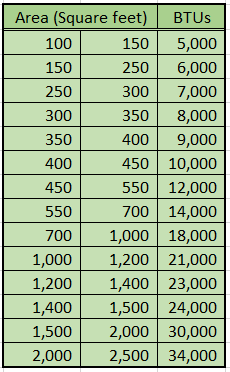 BTUs from square feet
The Math / Science
According the reference article below, the BTU requirements to cool a room are:
- BTUs are a function of square footage (see Table).
- 10% added if the room is in direct (full) sun.
- 10% reduced if the room is heavily shaded
- add 600 BTUs for all regular occupants above a normal 2 occupants.
- add 4,000 BTUs if the room is a kitchen.
General Information
It is important to choose the right size air conditioning unit for your room. A/C units do two things to greatly contribute to your comfort. First is to lower the temperature, but nearly as important, they remove humidity. That's why you'll see water dripping from an A/C unit. Lower humidity levels are much more comfortable in the summer and reduce the mustiness of furniture and materials in the room.
- If your unit is too small, it will not keep up with the cooling demand, and your room will stay too warm in the hottest part of the day.
- If your unit is too big, it will cool the room too quickly and not remove the humidity. You will have a cold and clammy room.

HVAC (Heating and Cooling) Calculators
- Air Change Rate: Computes the number of times per hour the air in a space changes based on the flow rate of fresh air and the volume of the space.
- Air Conditioner Size: Computes the number of BTUs needed to air condition a room with a window unit air conditioner based on the size of the room, number of occupants, sun exposure and use (kitchen or not).
- Arithmetic Mean Temperature Difference: Computes the mean temperature difference based on the temperatures of the primary and secondary inlets and outlets of a system.
- BTUs per hour to Heat a Room: Computes the energy (heat) required to heat a space of a certain volume by a specified temperature variance.
- Cross-section Area: Computes the cross-section area of a pipe or conduit based on the diameter.
- Heating and Cooling Load: Computes the amount of heat energy that conducts through a surface based on the temperature variance, surface area and coefficient of heat transmission.
- Heat Exchange Area: Computes the exchange material surface area required to achieve an overall heat transfer flow rate through a heat exchanger based on the heat transfer material coefficient, and the desired temperature difference at the two ends of the heat exchanger.
- Heating Load and Water Flow: Computes the ton of heat capacity associated with a volumetric flow of water and a change in temperature.
- Heat Loss through a Wall: Computes the amount of heat energy that conducts through a wall based on the temperature variance, surface area and coefficient of heat transmission.
- Heat Loss of a Room: Estimates the heat loss in a room based on the surface area of the interior of a rectangular room including the walls and ceiling, the temperature variance (inside and outside) and a coefficient of heat transfer.
- Temperature Transfer Efficiency: Computes the temperature transfer efficiency of a heat recovery unit.
- (U) Heat Transfer Coefficients: Description of the coefficient of heat transfer and the values associated with numerous materials.
- Insulation Calculator: Twenty (20) equations and data items related to insulation (rolls, cellulose. loose fiberglass and shake and rake)
- Ventilation Rate per Person: Computes the ventilation rate per person based on the flow rate of fresh air, volume of the space, occupant density and the ceiling height.
- Volume of a Room: Computes the volume of a room based on the height of the ceiling and the length and width of the floor.
Heat Science Calculators
- Specific Heat from Change in Temperature
- Specific Heat from Two Temperatures
- Specific Heat Lookup Table
- Heat Energy Needed to Change Temperature