The Cardiac Output from Stroke Volume and Heart Rate calculator computes the output of a heart based on the heart stroke volume and the heart rate.
INSTRUCTIONS: Choose units and enter the following:
- (SV) Stroke Volume
- (HR) Heart Rate
Cardiac Output (CO): The output is returned in liters per minute (L/min). However this can be automatically converted to compatible units via the pull-down menu.
The Math / Science
Cardiac is the volume of blood being pumped by the heart, particularly by the left or right ventricle in the time interval of one minute. The Cardiac Output from Stoke Volume and Heart Rate formula is:
CO = HR * SV
Where:
- CO = Cardiac Output
- HR = Heart Rate
- SV = Stroke Volume
Stats
The average stroke volume for a 154 pound man is 70 ml. An average resting cardiac output would be 5.6 L/min for a human male and 4.9 L/min for a female.
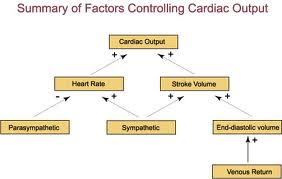
Cardiac Output (CO) may be measured in many ways, for example `dm^3`/min (1 `dm^3` equals 1 litre). CO is furthermore the combined sum of output from the right ventricle and the output from the left ventricle during the phase of systole of the heart.

Heart, Cardiology and Blood Calculators
- Cardiac Stroke Volume: Computes the volume blood pumped in one stroke based on the end diastolic and systolic volumes.
- Cardiac Output: Computes the output of a heart based on the heart rate, end diastolic volume and the end systolic volume.
- Cardiac Output with Stroke Volume: Computes the volume rate of blood pumped by the heart in one minute based on the beats per minute and the stroke volume.
- Ejection Fraction: Computes the Ejection Fraction percentage based on the end-systolic and end-diastolic volumes.
- Heart Stroke Work: Computes the amount of work performed by the heart during a single heartbeat to pump blood based on the Mean Arterial Pressure (MAP) and Stroke Volume(SV).
- Mean Arterial Press: Compute the mean arterial pressure and pulse pressure based on the diastolic pressure and the systolic pressure.
- Cardiac Stroke Work: Computes work done by the ventricle to eject a volume of blood into the aorta based on the afterload pressure, stroke volume, blood stroke mass and blood flow velocity.
- Cardiac Flow (Q): Computes the flow factor of an artery based on the diameter and blood flow velocity.
- Body Surface Area (BSA): Wide range of calculators in one function to compute the body surface area base on one of many common methods (e.g., Mosteller, Takahira)
- Hagen-Poiseuille Resistance: Fluid resistance of blood and plasma based on viscosity, length and radius of vessel.
- Poiseuille's Law: Fluid flow rate from change in pressure, length, diameter and viscosity
- Poiseuille's Velocity of Compressible Fluids: Fluid velocity based on tube radius and length, input and output pressures, and fluid viscosity.
- Heart Chamber Pressure via the Law of Laplace: Pressure on membrane wall based on wall stress, chamber radius and vascular wall thickness.
- Heart Wall Stress via the Law of Laplace: Stress on the membrane wall of based on the blood pressure, radius of the chamber (r) and the vascular wall thickness (T).
- Blood Flow Rate using Darcy's Law: Blood flow through a vessel based on a change in pressure and a resistance factor.
- Change in Vascular Pressure: Change in pressure at two points in a vessel.
- Blood Pressure: Blood pressure based on Cardiac Output and Blood Flow Resistance
- Mean Arterial Pressure (MAP): Calculates MAP from Pulse Pressure and Diastolic Pressure
- Mean Arterial Pressure and Pulse Pressure: Calculates MAP and Pulse Pressure from Diastolic Pressure and Systolic Blood Pressure
- Cardiac Output from Heart Rate and Stroke Volume: Output of a heart based on the heart stroke volume and the heart rate.