The Time to Sink calculator estimates the time it takes for the inflow of seawater to surpass the vessel's displacement based on the vessel's displacement and the flow rate of sea water entering the hull and the bilge pump rate out.
INSTRUCTIONS: Choose units and enter the following:
- (VDW) Vessel Displacement Weight
- (BFR) Breach Flow Rate (rate that seawater is entering the hull)
- (PR) Bilge Pump Rate (ejection pump rate of water leaving hull)
Max Time to Sink (MT): The calculator returns the time in hours and minutes. However, this can be automatically converted to compatible units via the pull-down menu.
The Math / Science
On the outside, best case scenario, a boat will sink when the weight of water coming in through a breach exceeds the displacement weight of the vessel. Conditions can make the demise (sinking) occur earlier, but the time to take on more water than the boat effectively displaces is the outer limit. The rate of taking on water is mitigated by the rate of a bilge pump. If the bilge pump ejects water faster than the boat is taking it on, the boat can float indefinitely.
Knowing how much time one has can be the difference between life and death in some circumstances. So please consider that this estimate MAY BE EXCESSIVELY OPTIMISTIC.
The formula used for the Time to Sink is:
t = (VDW/MDSW) / (BFR-PR)
where:
- t = time to sink
- BFR = Breach Flow Rate (water in)
- PR = Pump Rate (bilge pump rate out)
- VDW = Vessel Displacement Weight
- MDSW = Mean Density of Sea Water
Bilge Pump Flow Ratess
The flow rate of common sailboat bilge pumps varies depending on the pump type, size, and installation conditions. Below is a summary based on typical specifications and real-world performance:
Common Bilge Pump Types and Flow Rates
- Centrifugal Bilge Pumps (most common for sailboats): Rated Flow Rates: Typically range from 500 to 4,000 gallons per hour (GPH) or roughly 8 to 67 gallons per minute (GPM).
- Small boats (<20 feet): 500–1,000 GPH (8–17 GPM)
- Medium boats (20–36 feet): 1,500–4,000 GPH (25–67 GPM)
- Larger boats (>36 feet): 4,000–8,500 GPH (67–142 GPM)
- Expected Performance: Due to factors like head height (vertical lift), hose friction, and voltage drop, actual flow is often 60–70% of the rated capacity. For example, a 1,000 GPH pump may deliver ~600–700 GPH in practice.
- Diaphragm Bilge Pumps (used as secondary or for dry bilges):
- Rated Flow Rates: Typically lower, around 300–1,000 GPH (5–17 GPM). Some larger models reach up to 50 GPM, but these are less common.
- Expected Performance: These are self-priming and better at pumping uphill, but flow rates drop with debris or long hose runs. They’re often used for smaller boats or as backups.
- Manual Bilge Pumps (required on many sailboats):
- Flow Rates: Vary widely based on pump design and operator effort. Common models like the Whale Gusher Urchin deliver ~14.5 GPM at 60 strokes per minute, while the Whale Gusher Titan can reach ~28 GPM at 70 strokes.
- Expected Performance: Limited by human endurance, making them less effective for sustained high-volume pumping.
- High-Capacity Emergency Pumps (e.g., engine-driven or shaft-driven):
- Flow Rates: Can range from 3,600 GPH (60 GPM) for Jabsco belt-driven pumps to 24,000 GPH (400 GPM) for specialized models like the Fast Flow pump at 2,000 RPM.
- Expected Performance: These are for extreme emergencies (e.g., hull breach) and not typical for routine bilge management.
Factors Affecting Performance
- Head Height: Pumping water vertically (e.g., 3–6 feet on sailboats) reduces capacity by 30–40% or more. A 500 GPH pump may drop to 350 GPH with 3 feet of head.
- Hose Type and Length: Corrugated hoses reduce flow by up to 20% compared to smooth-bore hoses. Long runs or sharp bends further decrease performance.
- Voltage Drop: Most pumps are rated at 13.6V, but real-world battery voltage (e.g., 12V) can reduce capacity by 20%.
- Thru-Hull Fittings: Smaller or restrictive fittings can cut flow significantly, sometimes equivalent to adding several feet of hose.
- Debris: Centrifugal pumps handle small debris better but can clog, while diaphragm pumps require strainers to avoid valve issues.
Commend Pump Capacities for Sailboats
- Small Sailboats (<20 feet): 1,000 GPH total capacity, often one centrifugal pump.
- Mid-Size Sailboats (20–36 feet): 2,500–6,000 GPH, ideally split between a primary pump (e.g., 1,500 GPH) and a backup (e.g., 2,000 GPH).
- Larger Sailboats (>36 feet): 8,500 GPH or more, with multiple pumps (e.g., two 3,700 GPH pumps for a 40-foot sailboat).
- Backup Manual Pumps: A manual pump (e.g., 10–28 GPM) is often required for offshore sailing and should be operable from the cockpit or below deck.
Key Considerations
- Realistic Expectations: Bilge pumps are designed for nuisance water (rain, leaks) and may only delay sinking in emergencies. A 2-inch hole 3 feet below the waterline can flood at 139 GPM, overwhelming most standard pumps.
- Multiple Pumps: Many sailors use a two-pump system: a smaller automatic pump (400–500 GPH) for minor water and a larger pump (3,500+ GPH) for emergencies.
- Installation: Use smooth-bore hoses, proper wire sizes, and vented loops to prevent siphoning. Ensure pumps are accessible for maintenance.
Example Models and Brands
- Rule Pumps: Common centrifugal pumps with 500–4,000 GPH ratings. Reliable but not repairable.
- SEAFLO: Offers 500–2,000 GPH pumps, both automatic and manual.
- Attwood Sahara: 750–1,100 GPH, compact with automatic switches.
- Whale Gusher: Manual pumps with 14.5–28 GPM for backups.
- Fast Flow: Emergency shaft-driven pump, up to 24,000 GPH.
For precise flow rate estimates, check manufacturer specs for your boat’s setup (hose length, head height, voltage) and assume 60–70% of rated GPH in real conditions. If you provide your sailboat’s size or specific pump model, I can refine the estimate further.
Historical Note
The RMS Titanic took on water at an estimated rate of 7 tons (approximately 1,540 gallons or 7,000 liters) per second after hitting the iceberg. This translates to about 420 tons per minute or 252,000 gallons (approximately 1.14 million liters) per minute. This overwhelming rate of water ingress quickly exceeded the capacity of the ship's pumps, leading to its eventual sinking.

Sailing and Navigation Calculators:
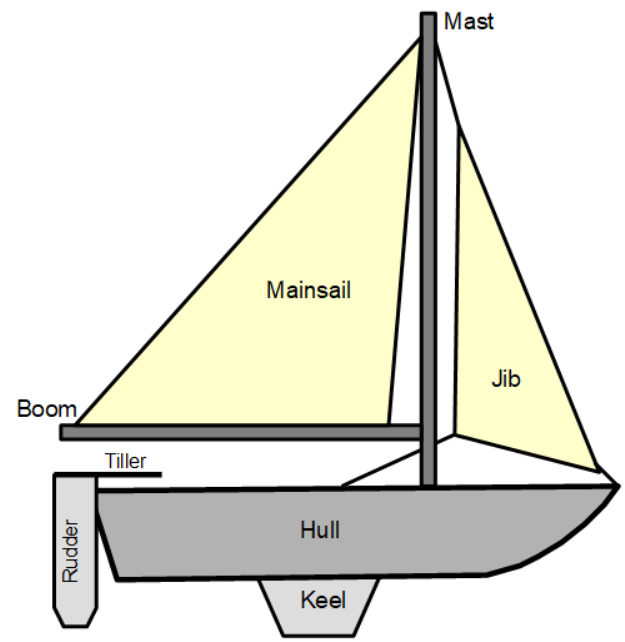 Bruce Number: Computes the ratio of the square root of sail area to the cube root of displacement of a sail boat
- Sail Area / Displacement Ratio: Compute SA/D ratio for sail boats.
- Displacement-Length Ratio: Computes a metric to describe how heavy a boat is in relation to its waterline.
- Capsize Screening Formula: Computes a metric to describe a boat's stability in rough seas.
- Vessel Displacement Volume: Computes the cubic feet displacement associated with the weight displacement.
- Weight of Seawater: Computes the weight and mass of a volume of seawater.
- Time to Sink: Compute the time it takes for a breach (water in) to surpass the displacement of the boat.
- Haversine Distance (decimal degrees): Compute the Distance Between two Points on the Earth (Great Circle Arc)
- Haversine Distance (Degrees, Minutes and Seconds): Compute the Distance Between two Points on a Sphere (Great Circle Arc) using degrees, minutes and seconds verses decimal degrees.
- Rhumb Line Azimuth: Computes the azimuth heading one can navigate for a path that crosses all meridians of longitude at a constant angle.
- Rhumb Line Distance: Computes the distance traveled between two points on the globe if traveled via a rhumb line.
- Correction Angle:
 navigation equation that compensates for air or water currents.
 - Decimal Degrees: Compute decimal degree angles from degrees, minutes and seconds,[CLICK HERE].
- Nautical Travel Cost: Computes the total cost to travel a distance based on the cost rate and distance traveled.
- Travel Time between Coordinates: Compute the time to travel between two location (latitudes and longitudes) based on a average speed
- Distance to Sea Level Horizon: Computes the distance to the horizon from a specified height using a spherical model the mean spherical radius of the Earth
Forensic Science Calculators
- Time to Overtake: Computes the time for one object to overtake another.
- Distance to Overtake: Computes distance traveled to overtake another.
- Speed to Overtake by Distance: Computes the average velocity to overtake another within a specified distance.
- Speed to Overtake by Time: Computes the speed needed to overtake within a specified time.
- Distance at Speed: Computes the distance traveled over a period of time at a constant velocity (speed)..
- Braking Distance: Computes the distance to stop a vehicle based on the initial velocity (vi) and the a braking coefficient (μ).
- Total Stopping Distance: Computes the distance to stop a vehicle based on the initial velocity (vi), reaction time (t) and the a braking coefficient (μ).
- Speed from the Braking Distance: Estimates the initial speed based on the distance to stop a vehicle (d) and the a braking coefficient (μ).
- Speed from Length of Skid Marks: Estimates the speed based on the length of skid marks and the friction coefficient.
- Minium Drive Time between Coordinates: Computest the minimum time it would take to drive between two GPS coordinates in a straight line at a specified speed.
- Time of Death: Computes the amount of time since a human has died based on the current body temperature and the ambient temperature of the air around the body.
- Time to Sink: Estimates the time it takes for the inflow of water to surpass the vessel's displacement based on the vessel's displacement and the flow rate of sea water entering the hull and the bilge pump rate out.