The Darcy's Law (Physiology) calculator computes the blood flow (F) through a vessel based on a change in pressure (ΔP) and a resistance factor (R).
INSTRUCTIONS; Choose units and enter the following: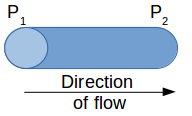
- (ΔP) Change in pressure between points (P1 and P2)
- (R) Resistance Factor.
Flow Rate (FR): The calculator returns the Flow Rate in milliliters per minute. However this can be automatically converted into other volumetric flow units via the pull-down menu.
The Math / Science
Darcy’s Law was created to describe the flow of a fluid through a porous medium, specifically the flow of water through sand. The law has been significantly simplified for this application to Physiology here. See Darcy's Law (Engineering) for the more explicit version of this equation as typically applied to hydrogeology and engineering applications.
In the physiology application, Darcy’s Law has been interpreted as defining blood flow against resistance, where the peripheral resistance of the circulatory system to blood flow is analogous to the resistance of a medium like sand to the flow of water. The two inputs to this equation are:
- Mean Arterial Pressure in units of mmHg - millimeters of mercury
- Total Peripheral Resistance in units of mmHg * (min/L)
Darcy's Law returns the cardiac output in terms of Liters per minute.
The Math
The Darcy's Law formula was derived from experimental data by Henry Darcy has the following form:
`Q = (-k*A (P_b - P_a)) / (mu * L)`, where
- k = the intrinsic permeability of the medium
- A = the cross-sectional area through which the fluid will flow
- `P_b - P_a` = the total pressure drop
- `mu` = viscosity of the fluid
- L = the length over which the pressure drop occurs
As you can see in contrast, the physiology version of "Darcy's Law" is somewhat simplified:
Cardiac Output = (Mean Arterial Pressure) / (Total Peripheral Resistance)

Heart, Cardiology and Blood Calculators
- Cardiac Stroke Volume: Computes the volume blood pumped in one stroke based on the end diastolic and systolic volumes.
- Cardiac Output: Computes the output of a heart based on the heart rate, end diastolic volume and the end systolic volume.
- Cardiac Output with Stroke Volume: Computes the volume rate of blood pumped by the heart in one minute based on the beats per minute and the stroke volume.
- Ejection Fraction: Computes the Ejection Fraction percentage based on the end-systolic and end-diastolic volumes.
- Heart Stroke Work: Computes the amount of work performed by the heart during a single heartbeat to pump blood based on the Mean Arterial Pressure (MAP) and Stroke Volume(SV).
- Mean Arterial Press: Compute the mean arterial pressure and pulse pressure based on the diastolic pressure and the systolic pressure.
- Cardiac Stroke Work: Computes work done by the ventricle to eject a volume of blood into the aorta based on the afterload pressure, stroke volume, blood stroke mass and blood flow velocity.
- Cardiac Flow (Q): Computes the flow factor of an artery based on the diameter and blood flow velocity.
- Body Surface Area (BSA): Wide range of calculators in one function to compute the body surface area base on one of many common methods (e.g., Mosteller, Takahira)
- Hagen-Poiseuille Resistance: Fluid resistance of blood and plasma based on viscosity, length and radius of vessel.
- Poiseuille's Law: Fluid flow rate from change in pressure, length, diameter and viscosity
- Poiseuille's Velocity of Compressible Fluids: Fluid velocity based on tube radius and length, input and output pressures, and fluid viscosity.
- Heart Chamber Pressure via the Law of Laplace: Pressure on membrane wall based on wall stress, chamber radius and vascular wall thickness.
- Heart Wall Stress via the Law of Laplace: Stress on the membrane wall of based on the blood pressure, radius of the chamber (r) and the vascular wall thickness (T).
- Blood Flow Rate using Darcy's Law: Blood flow through a vessel based on a change in pressure and a resistance factor.
- Change in Vascular Pressure: Change in pressure at two points in a vessel.
- Blood Pressure: Blood pressure based on Cardiac Output and Blood Flow Resistance
- Mean Arterial Pressure (MAP): Calculates MAP from Pulse Pressure and Diastolic Pressure
- Mean Arterial Pressure and Pulse Pressure: Calculates MAP and Pulse Pressure from Diastolic Pressure and Systolic Blood Pressure
- Cardiac Output from Heart Rate and Stroke Volume: Output of a heart based on the heart stroke volume and the heart rate.
References
- Ali Nasimi (2012). Hemodynamics, The Cardiovascular System - Physiology, Diagnostics and Clinical Implications, Dr. David Gaze (Ed.), ISBN: 978-953-51-0534-3, InTech, Available from: http://www.intechopen.com/books/the-cardiovascular-system-physiology-diagnostics-and-clinicalimplications/hemodynamics