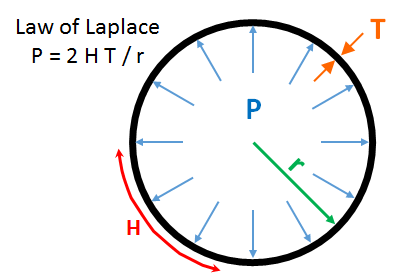
The Law of Laplace (Wall Stress) calculator computes the stress (H) on the membrane wall of based on the blood pressure (P), radius of the chamber (r) and the vascular wall thickness (T).
INSTRUCTIONS: Choose your preferred units and enter the following:
- (P) pressure
- (r) radius of chamber
- (T) wall thickness
WALL STRESS: The wall stress (H) is computed in Newtons/cm2). However the can be automatically converted to other stress or pressure units via the pull-down menu.
The Math/Science
The Wall Stress formula, H = P • r/(2•T), is based on Laplace's Law (physics) and is applied in the physiology of blood flow. Under equilibrium conditions the wall stress on a heart chamber containing a fluid is proportional to the pressure in the chamber and the radius of the chamber for a spherical approximation. This law is called either Laplace's Law or the Law of Laplace.
For a given pressure, increased radius requires increased wall thickness to accommodate a stable wall stress; also, increased pressure requires increased thickness to maintain a stable wall stress. The latter is used to explain thickening of arteries and thickening of the left ventricle to accommodate high blood pressure. However, the thickened left ventricle is stiffer when the thickness is normal, so it requires elevated pressures to fill, a condition known as diastolic heart failure.
Using the physiological application of the Law of LaPlace we can examine the course of systolic heart failure. As the systolic heart failure continues, the end-diastolic volume of the heart might increase. With volume increase the radius increases and the Law of Laplace equation then tells us the pressure generated decreases. This makes the heart problem worse, as the failing ventricle has to work harder to keep up the blood pressure. The dilated ventricle requires more wall stress in the wall to generate the same pressure.
The wall stress, here the left ventricle's wall stress, is produced by the force acting against the myocardial cells.
This wall stress is directly proportional to left ventricle's pressure and radius. This simple relationship helps us understand what conditions can affect oxygen flow and which therapies can relieve angina. The following are some of the ways the pressure/radius/wall thickness/wall stress relationships help identify cause and treatment:
- Left ventricular pressure increases with symptoms of increased “afterload” of the heart, including systemic hypertension and aortic valve stenosis.
- In heart valve disorders or cardiomyopathies, the left ventricle's radius increases causing systolic heart failure.
- Left ventricular wall thickness increases to compensate for increased wall stress, when a patient encounters chronic hypertension or aortic valve stenosis.
- Hypertrophic obstructive cardiomyopathy (HOCM) increases wall thickness. After myocardial infarction, the wall thins which increases wall stress.
- The treatment of stable angina is typically involves reducing wall stress and decreasing myocardial oxygen demand.
Note: in physics stress is defines as the force applied across a unit area. Stress describes the force one part of a body applies to adjacent parts.

Heart, Cardiology and Blood Calculators
- Cardiac Stroke Volume: Computes the volume blood pumped in one stroke based on the end diastolic and systolic volumes.
- Cardiac Output: Computes the output of a heart based on the heart rate, end diastolic volume and the end systolic volume.
- Cardiac Output with Stroke Volume: Computes the volume rate of blood pumped by the heart in one minute based on the beats per minute and the stroke volume.
- Ejection Fraction: Computes the Ejection Fraction percentage based on the end-systolic and end-diastolic volumes.
- Heart Stroke Work: Computes the amount of work performed by the heart during a single heartbeat to pump blood based on the Mean Arterial Pressure (MAP) and Stroke Volume(SV).
- Mean Arterial Press: Compute the mean arterial pressure and pulse pressure based on the diastolic pressure and the systolic pressure.
- Cardiac Stroke Work: Computes work done by the ventricle to eject a volume of blood into the aorta based on the afterload pressure, stroke volume, blood stroke mass and blood flow velocity.
- Cardiac Flow (Q): Computes the flow factor of an artery based on the diameter and blood flow velocity.
- Body Surface Area (BSA): Wide range of calculators in one function to compute the body surface area base on one of many common methods (e.g., Mosteller, Takahira)
- Hagen-Poiseuille Resistance: Fluid resistance of blood and plasma based on viscosity, length and radius of vessel.
- Poiseuille's Law: Fluid flow rate from change in pressure, length, diameter and viscosity
- Poiseuille's Velocity of Compressible Fluids: Fluid velocity based on tube radius and length, input and output pressures, and fluid viscosity.
- Heart Chamber Pressure via the Law of Laplace: Pressure on membrane wall based on wall stress, chamber radius and vascular wall thickness.
- Heart Wall Stress via the Law of Laplace: Stress on the membrane wall of based on the blood pressure, radius of the chamber (r) and the vascular wall thickness (T).
- Blood Flow Rate using Darcy's Law: Blood flow through a vessel based on a change in pressure and a resistance factor.
- Change in Vascular Pressure: Change in pressure at two points in a vessel.
- Blood Pressure: Blood pressure based on Cardiac Output and Blood Flow Resistance
- Mean Arterial Pressure (MAP): Calculates MAP from Pulse Pressure and Diastolic Pressure
- Mean Arterial Pressure and Pulse Pressure: Calculates MAP and Pulse Pressure from Diastolic Pressure and Systolic Blood Pressure
- Cardiac Output from Heart Rate and Stroke Volume: Output of a heart based on the heart stroke volume and the heart rate.