The Acceleration Due to Gravity calculator computes the acceleration due to gravity (g) based on the mass of the body (m), the radius of the body (R) and the Universal Gravitational Constant (G) .
INSTRUCTIONS: Choose units and enter the following:
- (m) Mass of object
- (R) Distance to object. (Earth’s Equatorial Radius (WGS-84): 6378.137 km)
Acceleration Due to Gravity (g): The acceleration is returned in meters per second. However, this can be automatically converted to compatible units via the pull-down menu.
Note: vCalc provides special mass and distance units for application in space sciences. The mass units include Earth Mass, Jupiter Mass and Solar Mass. The distances include Astronomical Units (ua), Light Seconds, Minutes, Hours, Days and Years, Parsecs, Kilo-Parsecs and Kilo-Light Years.
The Science
Acceleration due to gravity is the instantaneous change in downward velocity (acceleration) caused by the force of gravity toward the center of mass. Acceleration due to gravity is typically experienced on large bodies such as stars, planets, moons and asteroids but can occur minutely with smaller masses. The acceleration due to gravity is different based on the mass of the star, planet, moon or asteroid and the distance from its center of mass and its surface. For that reason, gravity has a lesser pull on bodies of lesser mass or density than the Earth such as the moon. The formula for acceleration due to gravity is: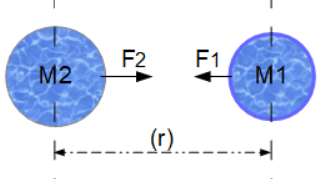
g = (G•M)/R²
Where:
- g is the acceleration due to gravity.
- G is the Universal Gravitational Constant (G)
- M is the mass of the object (e.g. planet)
- R is the distance to the center of mass of the object. The default used above is the mean spherical radius of the Earth.
Acceleration Due to Gravity in the Solar System:
- g(Sun) = 274 m/s²
- g(Mercury) = 3.7 m/s²
- g(Venus) = 8.87 m/s²
- g(Moon) = 1.62 m/s²
- g(Earth) = 9.80665 m/s²
- g(Mars) = 3.71 m/s²
- g(Jupiter) = 24.79 m/s²
- g(Saturn) = 10.44 m/s²
- g(Uranus) = 8.87 m/s²
- g(Neptune) = 11.15 m/s²
- g(Pluto) = 0.62 m/s²
See Also
- Force of Gravity equation computes the gravitational force between two masses. In this equation, the masses are treated as point masses separated by a specified distance.
- Universal Gravitational Constant (G) is 6.67384E-11 m³ / kg • sec².

Gravity Calculators:
Reference
- http://en.wikipedia.org/wiki/Gravitation
- http://en.wikipedia.org/wiki/Newton%27s_law_of_universal_gravitation