The 6x6s for a Retention Wall calculator computes the number of 6x6s are needed for a retention wall. 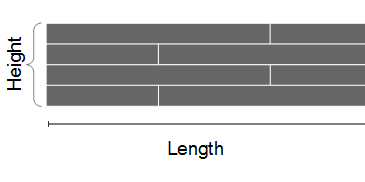
INSTRUCTIONS: Choose units and enter the following:
- (L) Length of Retention Wall
- (H) Height of the Retention Wall
- (BL) 6x6 Board Length
- (MX) Minimum Cut-off Reuse Length
- This is the minimum short 6x6 segment that is reused in next row.
6x6s Needed: The calculator returns the number of 6x6s needed to build a vertical retention wall. Specifically, the calculator returns:
- (nB) Total number of 6x6s needed of user specified (BL) length.
- (nR) Number of rows of 6x6s
- (PBR) Number of Boards per Row
- (TW) Total Weight of all the 6x6s
- (wt) Weight of Individual 6x6 boards
The Math / Science
The Retention Wall formula for 6x6s calculates the number of 6x6s needed to build a wall based on the length and height of the wall, and based on the assumption that the wall is one unit deep. The algorithm first computes the number of rows. Then, it step through each row to determine the number of 6x6s needed taking into account the cutoffs from the previous row, but only if the cutoffs are larger than the minimum cutoff length (MX).
Note: pressure treated 6x6s are heavy! The weight calculation uses an approximate pound per inch of 6x6. This is an estimate, but not far off based on the moisture content of the boards. The total weight (TW) of the 6x6s is included for consideration when moving them. One can easily exceed the safe limit of one's truck with a load of 6x6s. At least one retailer sells pressure treated 6x6s in lengths of 6', 8', 10', 12', 14', 16', 18', 20', 22', 24' and 26' !!!! The 26' long 6x6 weighs in excess of 300 pounds!

6x6 Price Survey
The 6x6 Lumber Pricing table contains recent lumber prices for pressure treated 6x6s of a variety of lengths with prices from Lowes, Home Depot, Menards and potentially other stores based on their web sites.
Pressure Treated 6x6 Price Survey:
- 6x6 Price Survey Date: 7/28/25

- 6x6 Price Survey Store: Menards
- Price by Length
- Price of a 4' 6x6: $29.39
- Price of a 6' 6x6: $34.48
- Price of an 8' 6x6: $36.48
- Price of a 10' 6x6: $53.78
- Price of a 12' 6x6: $60.48
- Price of a 14' 6x6: $74.69
- Price of a 16' 6x6: $81.68
- Price of a 18' 6x6: $101.09
- Price of a 20' 6x6: $112.39
- Price of a 22' 6x6: $123.59
- Price of a 24' 6x6: $134.79
- Price of a 26' 6x6: $173.09
All prices are in U.S. dollars and based on searches of nationally advertised prices from the provider's web sites. Search string: "6x6 lumber" is used in the retailer's website. The term four by four (6x6) refers to the rough cut dimensions of construction grade lumber. The typical 6x6 purchased at a lumber yard is actually `5 1/2`" x `5 1/2`". Nonetheless, the term 6x6 persists.
NOTE: Local pricing should ALWAYS, ALWAYS, ALWAYS be used! These price points are for estimation convenience only, and there is no guarantee on the prices of the product nor of their availability at the stated price.
A Retention Wall is a vertical or diagonal wall structure used to retain soil or 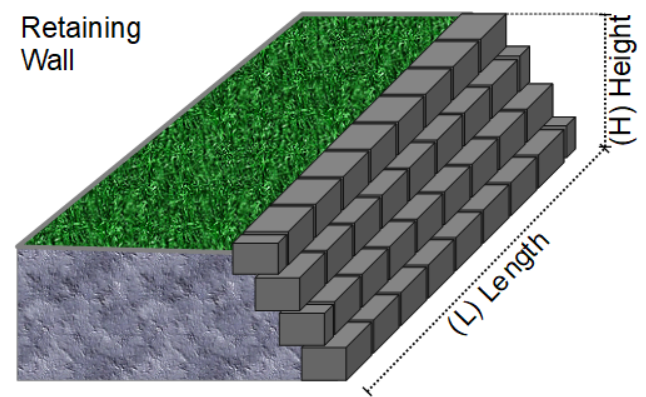 water at an elevated height on one side of the wall, keeping it above the natural level that the soil or water would achieve. Retention walls are used to create relatively flat areas such as roads or gardens that are cut into a hillside. Retention walls are also used as levees to keep water out of an area. The soil and moisture on one side of the wall exerts pressure (stress) on the wall. This is why the materials used must be appropriate for the application in both density and porosity.