vCalc equations have access to the vCalc Units engine. 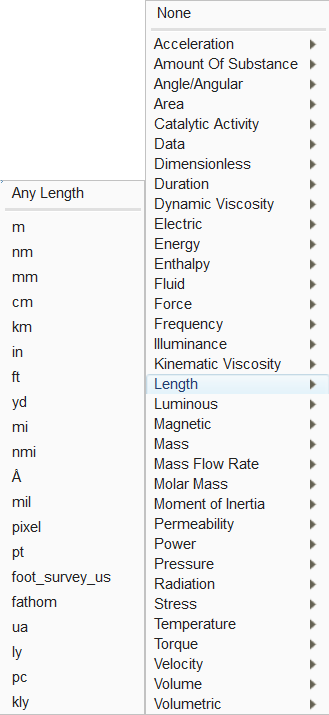 Length Units and Unit Classes The power of this unit engine can make a simple equation drastically more useful in many more situations. For example, simple geometric formulas now have a wider range of uses since the input length dimensions can automatically include the length units shown to the right, and make the simple formula for a the volume of an ellipsoid can now be used to calculate the volume of a bird egg with inputs of centi or millimeters or an elliptical galaxy a with inputs in kilo-lightyears, and vCalc handles the conversions automatically producing cubic units (cubic miles, cubic kilometers etc).
Furthermore, the units engine understands how many units combine. For example, two lengths produce an area. Three produce a volume. But there are many, many more relations known to vCalc's units engine with regard to motion, forces and energy in many forms. The second column (on the right) will give you the sense of the number of classes of units.
vCalc's Units Engine lets the user choose the input units that are available or comfortable to them, which vCalc then manages automatically. vCalc provides an automatic user interface for inputs with units, and a users interface for the output results. This latter option lets the user automatically convert their answers into any of the available units.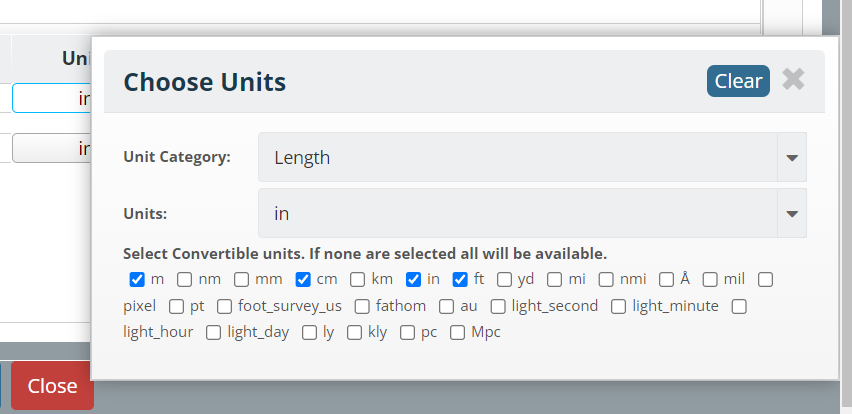
vCalc lets the content creator specify which units are available to the end user within a class. In the example shown, the units available for a length of tile is limited to feet (ft) and inches (in) and centimeters (cm) and meters (m).
vCalc's unit engine also manages the relationships between units. It knows that a length times a length produces an area, and such products will be displayed in area units. These different types of units are called unit classes.
vCalc currently has over 450 units in 50 unit classes and subclasses and this expands on a regular basis.
Examples of Units at work can be seen in the following:
- Any equation in the physics Pendulum Calculator
- Any equation in the Combustion Engine Calculator
To implement units, go to the Equation Editor's Algorithm Tab.
To specify a list of values with units for the input of a parameter, the value with the unit symbol is listed separated by a comma. This limits the inputs to the specified list. Not that units can be mixed but must be of the same type. In the example below, the values for parameter L are 2 inches, 2 centimeters and 4 inches, with a default of 4 inches.
