The Hyperboloid Surface Area calculator computes the surface of a hyperboloid based on the dimensions.
INSTRUCTIONS: Choose units and enter the following:
- (a) Formula Denominator a
- (c) Formula Denominator c
- (h) Height (length along perpendicular bisector)
Hyperboloid Surface Area (SA): The surface area is returned in square meters. However, this can be automatically converted to compatible units via the pull-down menu.
SPECIAL THANKS to Camil Moujaber for identifying a problem in the original Hyperboloid Surface Area formula used in this calculator.
The Math / Science
The Hyperboloid Surface Area equation computes the surface area of a one-sheet hyperboloid. The formula for the surface area of a one-sheet hyperboloid is:
`SA = 2*pi*a [ (h*sqrt( 4c^4+(a^2+c^2)h^2) ) / (4c^2) + (c^2 sinh^-1 ( ( h sqrt(a^2 + c^2))/(2c^2)) )/sqrt(a^2 + c^2) ] `
where:
- SA = Surface Area of one-sheet hyperboloid
- c & a are parameter from the definition of the hyperboloid (see below)
- h = distance from apex along perpendicular bisector
A hyperboloid is a surface that may be obtained from a hyperboloid of revolution by deforming it by means of directional scalings, or more generally, of affine transformations. A hyperboloid is a quadric surface, meaning that it is defined by a polynomial equation of degree 2 in three variables.
There are different types of hyperboloids. The most common ones are: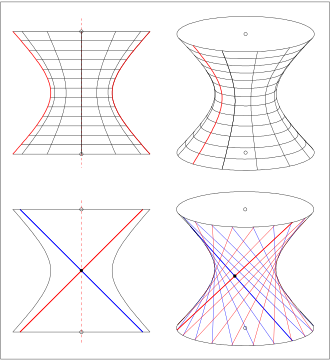
Hyperboloid of one sheet: This type of hyperboloid has two asymptotic cones and resembles two nested cones opening in opposite directions. Its equation in Cartesian coordinates is typically of the form:
` x^2 / a^2 + y^2/b^2 - z^2/c^2 = 1`
where a, b, and c are constants determining the shape and orientation of the hyperboloid along the three axes.
Hyperboloid of two sheets: This hyperboloid has two disconnected parts, each resembling a hyperboloid of one sheet. Its equation is similar to the hyperboloid of one sheet but with opposite signs:
` x^2 / a^2 + y^2/b^2 - z^2/c^2 = -1`
Hyperboloids find applications in mathematics, physics, engineering, and architecture due to their interesting geometric properties and structural stability. For instance, they are used in the design of cooling towers, as well as in optics and acoustics.