The Porosity Percentage calculator computes the porosity percentage based on the total volume and the volume of the voids.
INSTRUCTIONS: Choose units and enter the following:
- (VV) Volume of Voids
- (VTotal) Total Volume
Porosity Percentage (PP): The calculator returns the porosity as a percentage.
The Math / Science
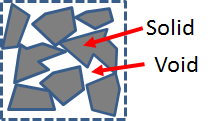
The Porosity Percentage calculator computes the porosity of a medium. The porosity represents the relative amounts of space occupied by the "voids" in a volume of material, where the voids can be a combination of liquids or gases.
This porosity percentage is a measure of how compact the material is. A volume of large rocks will obviously have a great deal of space between them and thus have a large porosity percentage compared to fine particulate of a volume of a clay soil, which would have very limited amounts of voids.
The inputs to this equation are the total sample volume, `V_"Total"`, and the volume observed to be occupied by voids `V_V`.
Notes
In engineering application the porosity is used to indicate a tendency of a material to expand or contract. A high porosity percentage is likely to be seen in loose soils which then will contract under pressure or added loads. A low porosity percentage represents a material that is dense. This porosity percentage affects how fluids will flow through a medium or how particulates can move through the medium.