The Four-Sided Field Size Acre calculator computes the area of a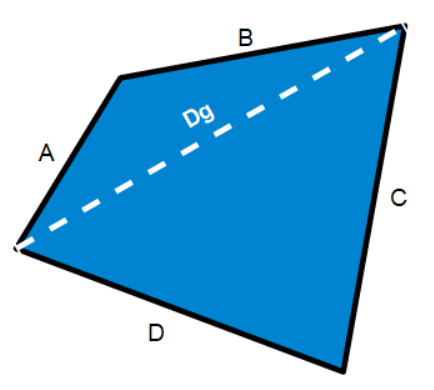 field with four straight sides given the length of the four sides and the length of a diagonal between opposing corners.
INSTRUCTIONS: Choose units and enter the following:
- (A) Length of side a
- (B) Length of side b
- (C) Length of side c
- (D) Length of side d
- (Dg) Length of the diagonal (See Diagram)
Acres in a Field (A): The calculator returns the area in acres and square feet. However, these can be automatically converted to compatible units via the pull-down menu.
The Math / Science
Start in one corner of your field, and measure the length of the four sides (A,B,C,D). Then from the original corner, measure the diagonal (Dg) to the far corner. See diagram. Then enter measurements above. The area of a four sided field calculation breaks the field into two triangles. That is why the diagonal (Dg) is needed. The first triangle has sides of A, B and Dg. The second triangle has side of C, D and Dg.
The formula for the area of a triangle based on the length of the three sides is:
`A = sqrt((a+b+c)/2((a+b+c)/2-a)((a+b+c)/2-b)((a+b+c)/2-c)) `
where:
- A is the area of the triangle
- a is the length of one side
- b is the length of one side
- c is the length of one side

Land Size Calculators
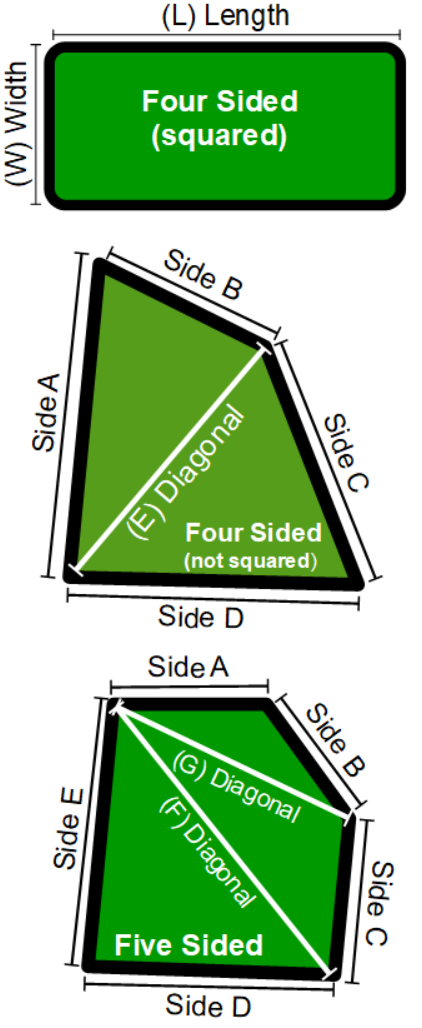 Three Sided Land Size: Computes the square feet, acres and perimeter in land with three straight sides.
- Four Sided Land Size (squared): Computes the area in square feet and acres and perimeter in feet of rectangle land with roughly squared corners based on the length and width.
- Four Sided Land Size (not squared): Computes the area and perimeter of four sided land based on side lengths and a length of a diagonal.
- Five Sided Land Size: Computes the area and perimeter of a five sided land based on side lengths and the lengths of two diagonals.
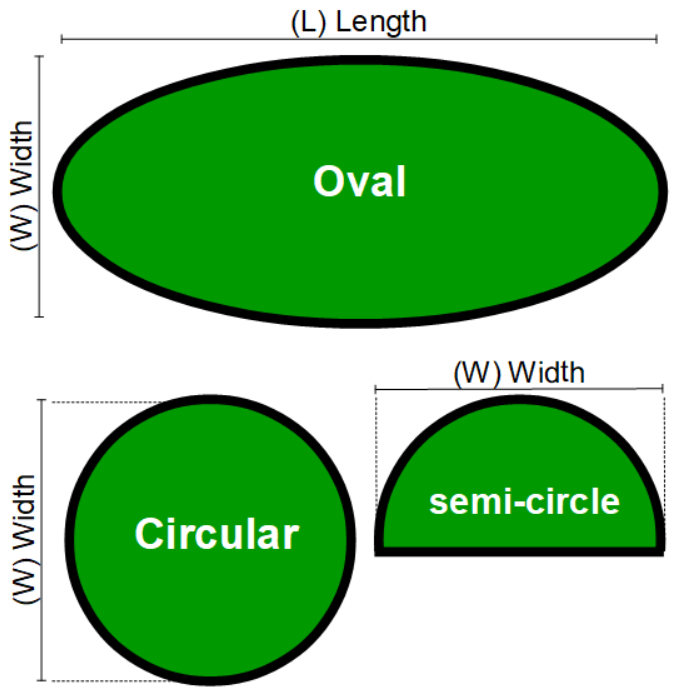
- Circular Land Size: Computes the area of land in roughly circular shape based on the width (diameter).
- Simi-Circular Land Size: Computes the area of land in roughly semi-circular shape based on the width (diameter).
- Oval Shaped Land Size: Computes the area of land in roughly an oval (ellipse) shape based on the length and width.
- Human Paces to Feet and Meters: Estimates a length (feet, yards and meters) based on the number of paces a person takes to walk it and the approximate length of stride.
Walking Measurements
 For large areas (lawns, gardens or fields), it may be hard to measure longer lengths, because you have no measuring device to make the long measurements (electronic device or long measuring tape or twine). In this case, an estimate can be achieved by using paces (your steps).
To estimate a length with paces, you first have to make a reasonable estimate of a regular pace while in stride. To do this, put a mark on the ground, and step back several paces. Start walking to the mark, and start counting some number of paces past the mark (e.g. 10). A that point, stop and measure the length. For example a man of six feet tall with a normal stride walked 14 paces in 40 feet. That gave him a feet per pace of 2.857 feet per pace. To compute the Feet per Pace, CLICK HERE. You can then walk off the measurements, using a steady pace, and convert the Paces to Feet by CLICKING HERE. It's a rough estimation method, but not without it's uses.
Often it is required to put land pieces together to compute to total area of land. The land shown can be accurately computed by individual triangles. The area of 5 sided land function requires the diagonals that create three triangles that are summed to compute the area in a 5 sided piece of land.
