Processing...
` = 2,200 " ft/sec"`
2200
The Muzzle Velocity of a 30-40 Krag is 2,200 feet per second.
.30-40 Krag
The .30-40 Krag is a centerfire rifle cartridge that was introduced in 1892 as the standard-issue round for the U.S. military. It was chambered in the Krag-Jørgensen rifle, which became the first bolt-action rifle adopted by the U.S. Army. The cartridge is historically significant as it marked the Army's transition from black powder to smokeless powder ammunition.
Key Characteristics of the .30-40 Krag:
- Caliber: .30-inch bullet diameter.
- Powder: Originally loaded with 40 grains of smokeless powder.
- Bullet Weight: Typically 220 grains.
- Muzzle Velocity: Approximately 2,000 feet per second (ft/s), depending on the load.
- Case: Rimmed bottleneck design, which facilitates extraction in bolt-action rifles.
Historical Use:
- The Krag rifle and its .30-40 Krag cartridge were used by the U.S. Army in the Spanish-American War (1898) and the Philippine-American War.
- Although the Krag rifle was praised for its smooth bolt action, it had disadvantages compared to Mauser-designed rifles of the same era, which offered better magazine systems and higher velocities.
- By 1903, the .30-40 Krag was replaced by the .30-03 and subsequently the .30-06 Springfield cartridge.

Firearm Calculators
- Sectional Density: Computes the factor used in the computation of the ballistic coefficient called sectional density.

- Bullet Ballistic Coefficient: Computes factor that represents a bullet's ability to overcome air resistance in flight.
- Ballistic Coefficient from Bullet's Mass, Diameter and Form Factor: Estimates the ballistic coefficient from the mass, diameter and form factor
- Miller Twist Rule: Computes the optimal barrel twist rate for stabilizing a bullet's flight given the bullet's diameter, length and mass.
- Taylor Knock-out Factor: Calculates a factor indicating the power of a round,.
- Greenhill Formula for Optimal Rifling Twist Rate: calculate the optimal barrel twist rate for stabilizing a bullet's flight given the bullet's diameter, length, specific gravity and velocity.
- Bullet Flight Range: Computes the maximum range (horizontal distance) traveled by a bullet based on the muzzle velocity, elevation angle and shooter height.
- Muzzle Energy of a Projectile: Calculates the kinetic energy in a bullet immediately after leaving the barrel given the bullet's mass and velocity.
- Recoil Velocity of a Gun: Computes the velocity at which a gun will move in the opposite direction in relation to the projectile that it fired.
- Cost per Round: Computes cost per round of ammunition based on the cost of a container of cartridges and the number of rounds in the container.
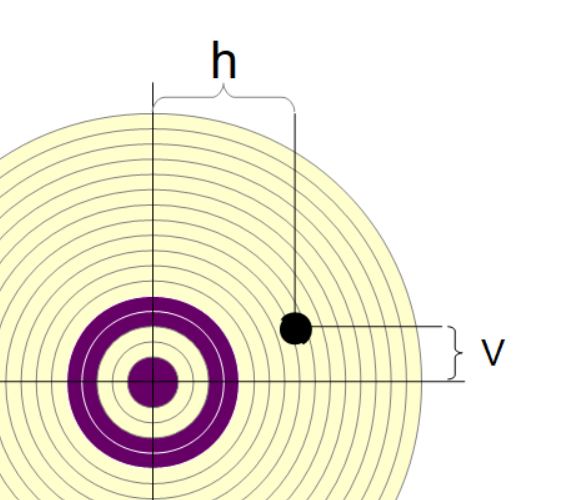 Rifle Sight Correction Angles: Computes the Minutes of Angle corrections for rifle sights.
- Shotgun Shell Reloading Cost: Computes the cost to reload used shotgun shells (hulls) with powder, shot, wads and primers.
- Shotgun Shell Loading Cost: Computes the cost to load new pre-primed shells (hulls) with power, shot and wads.
- Metal Ball Weight: Computes the mass (weight) of a spherical metal (e.g., steel) ball based on the size (diameter).
- Metal Cylinder Weight: Computes the mass (weight) of a metal cylinder based on the size (diameter and length).
