The Rankine–Hugoniot conditions, also referred to as Rankine–Hugoniot jump conditions or Rankine–Hugoniot relations, describe the relationship between the states on both sides of a shock wave in a one-dimensional flow in fluids or a one-dimensional deformation in solids.
They are named in recognition of the work carried out by Scottish engineer and physicist William John Macquorn Rankine and French engineer Pierre Henri Hugoniot.
The Rankine-Hugoniot condition describes the conservation laws (mass, momentum, and energy) across a shock wave or discontinuity in a compressible fluid flow, such as in gas dynamics. These conditions are derived from the integral form of the conservation laws applied across a control volume that straddles the shock.
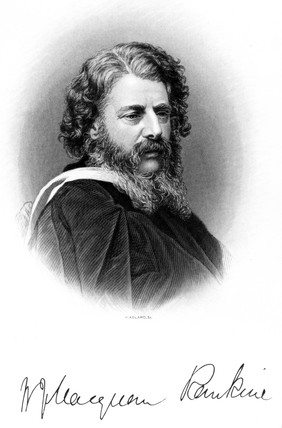
(Above) A photo of William John Macquorn Rankine and his signature. (Click here to see more)
Resource:
- "Formulae for Ammunition Management." International Ammunition Technical Guideline. 1st ed. New York: UN, 2013. 2-3.UN SaferGuard. United Nations Office for Disarmament Affairs (UNODA), 20 May 2013. Web. 12 June 2015. <http://www.un.org/disarmament/convarms/Ammunition>.
- Wikipedia. Wikimedia Foundation, n.d. Web. 21 June 2015. <https://en.wikipedia.org/wiki/Rankine%E2%80%93Hugoniot_conditions>.