This is the collection of equations needed to perform a simple two body orbit propagation.
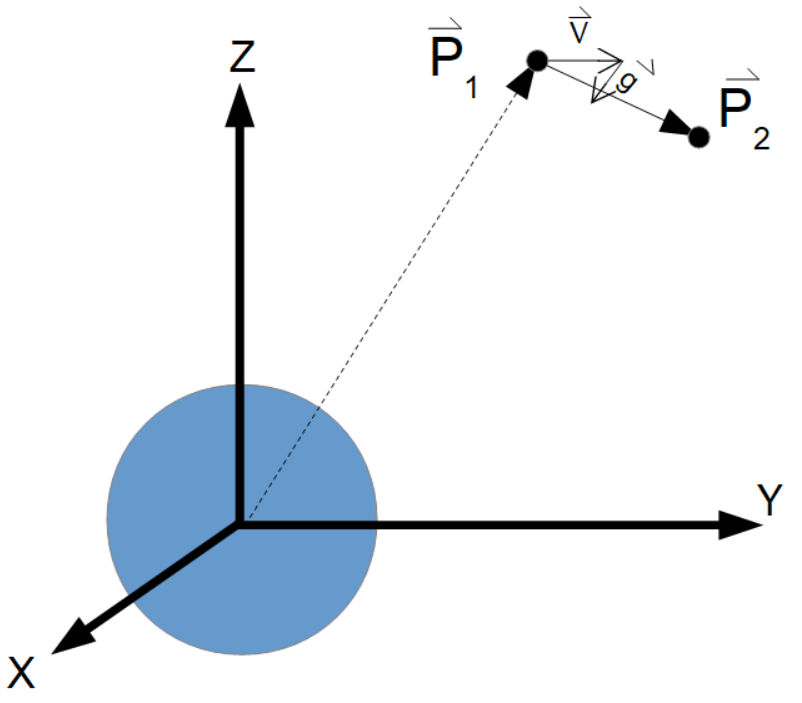
Kepler's Third Law tells us that orbits are elliptical (shaped like an ellipse). The forces working on an orbit include force of gravity, the force of drag, and potentially magnetism.
The simplest orbit predictions are called the two body orbits where the masses are considered point masses and the only force at work is gravity. Furthermore, the ratio of the masses are such that one mass is negligible compared to the second.
To compute the future position of a satellite (P2) using the two body method, one needs to know the initial position (P1) and velocity (V1) vectors of the satellite and the mass of the planet. In our example we will use the mass of the Earth.
This Ephemeris Generation utility is a simple Two Body calculation of orbital motion. It is reasonably accurate over short durations. It takes into account the acceleration due to gravity as a function of the distance of the satellite from the center of the mass of the Earth, treating both the satellite and the Earth as point masses. It does NOT take into effect the fact that the Earth is not a perfect sphere, but is oblate with a bulge around the equator. The effect of Earth oblateness is commonly know as J2 effects.
The Orbit Position and Velocity equation computes the position and velocity of a satellite in Earth orbit based on it's initial position and velocity and a period of time (time delta). The algorithm is as follows.
- Compute the magnitude of the position vector |`vecP_1`|.
- Confirm that it's greater than 6580 kilometers. Otherwise, the satellite is in the atmosphere.
- Compute the magnitude of the velocity vector |`vecV`|
- Compute the acceleration due to gravity at that position.
- Compute the gravity acceleration vector which is opposite to the position vector and of a magnitude equal to the acceleration due to gravity (step 4).
- Compute the gravity effect on velocity (vector), which is the acceleration vector times the time delta.
- Compute the final velocity vector by adding the gravity effect vector with the initial velocity vector.
- Compute final velocity effect on position by multiplying the final velocity vector by the time delta.
- Compute the final position vector by adding the final velocity effect vector times the time delta and the initial position vector
Essential formulas used above:
- P = V ⋅ dt
- V = a ⋅ dt
- a = g = G ⋅ M / R2
- R = vector magnitude of P
- Unit Vector of P
- Vector Scalar Multiplication (`-1*g*|vecP|`)
- Vector Addition
- G = Universal Gravity Constant
- M = Mass of the Earth
This utility loops over the about steps in increments of time equal to the Delta Time.