To Weed or Not to Weed?
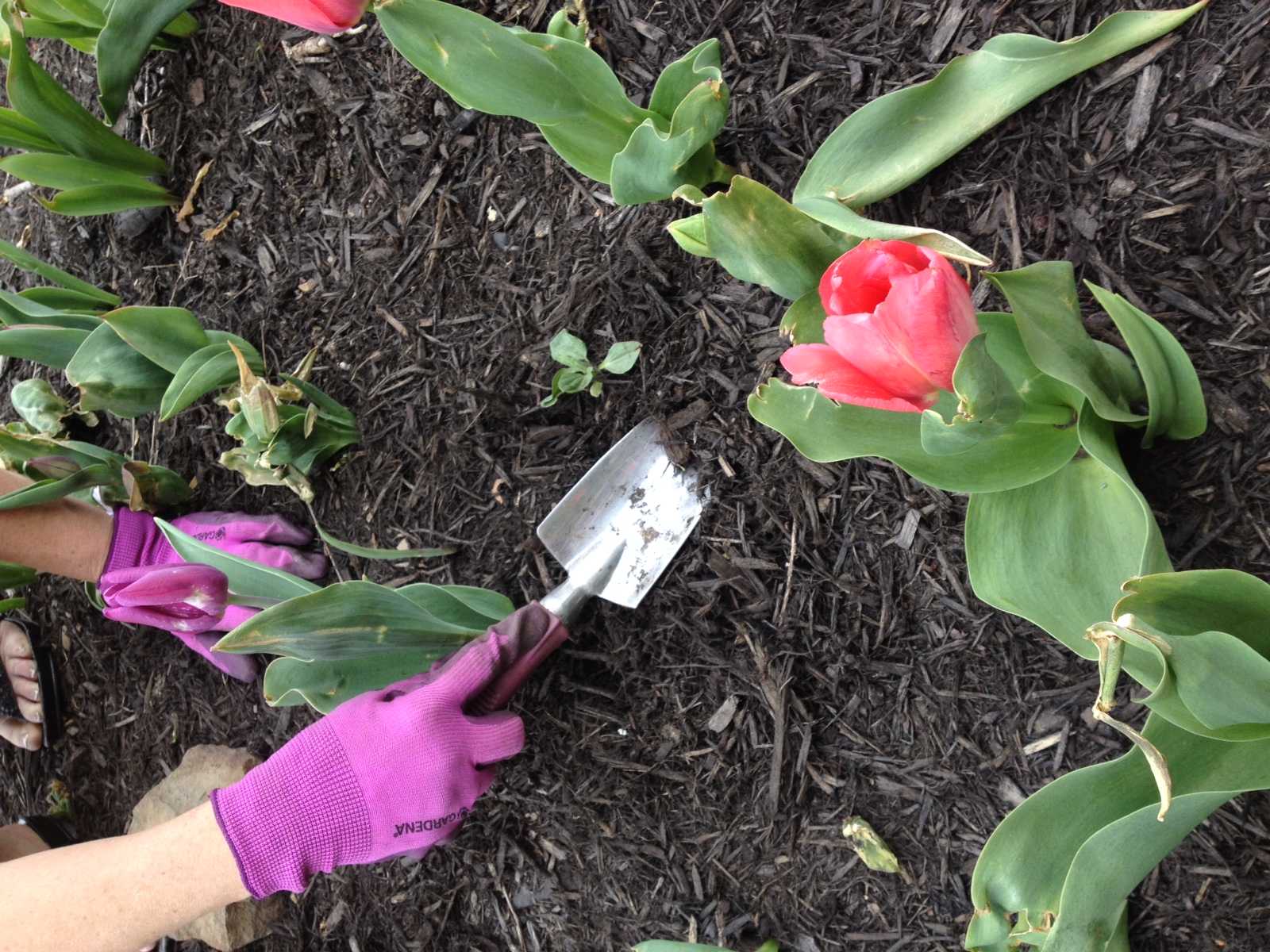 Mulch and Flowers
Okay. It’s getting warmer and you’ve started cutting your grass. After the long winter, you don’t mind doing the job (yet). But on your first pass, you notice that the pretty little garden on the edge of your yard has some flowers and WEEDS!!
And so the annual battle for your patch of land begins. You want to have only a certain set of plants in addition to your grass, but Mother Nature wants all of her seedlings sprouting in your (her) yard too. So, you can either settle on pulling weeds all spring, summer and fall, or you can repel the invaders with your own fortress. But instead of stone walls to keep out the Visigoths, your fortress is a weed barrier.
The two weed barriers that we recommend work well together. The first is Garden Fabric, which is a durable and water permeable cloth that you can buy at any garden center including Menards, Lowe’s and Home Depot, and on top of the garden fabric, we put mulch. Mulch also lets water through, and blocks weeds but it also helps retain warmth (heat units) which is important to growth, especially in the early spring and late fall.
Mulch comes in different colors, types of wood, as straw or hay and even in rubber. There are a few things to consider when buying mulch. First, pick the color you want to accent your yard. Think of the kinds of plants you have and imagine what they will look like with a backdrop of the different colors of mulch. Black is usually good if you can’t decide.
Types of Mulch
Wood Mulch comes in three ways: bags, bulk and make your own. Hay and straw can also be used as mulch and comes in bales. Read about your options, and then we'll help you figure out how much mulch you will need (see below: How Much Mulch).
Bags of Mulch
For most people, you’re going to get bags of mulch at the garden center and put them in your trunk or the back of your SUV or mini-van. This works well and can be high quality, but it’s also the most expensive source of mulch. As recently as 7/14/25, the price of a cubic foot of pine mulch was surveyed on the website of Lowes at $2.64 USD/ft³. If you go to Lowe's or Home Depots most of their mulch comes in 2 cubic feet bags.
Bulk Mulch
But if you have a truck or can borrow one, you have another option, bulk mulch. Bulk mulch is often cheaper. We are currently getting bulk mulch for $35 per cubic yard. That’s $1.29 per cubic foot (vs the number above) and is comparable to $2.58 for a 2 cubic foot bag.
Nonetheless, Lowe's at the time of this writing (5.2.2018) had a sale of 5 bags of mulch for $10. So the moral of the story is, DO THE MATH. The Bulk verses Bag Price Comparison Calculator performs the unit and currency conversions and will tell you which item is cheaper and by what percentage.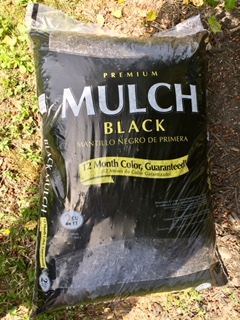
But there are some things you should know.
- Advice #1: Use gloves. Mulch is often dyed to create the attractive colors. Unless you want your hands to turn colors, use gloves.
- Advice #2: You’ll need to cover your load of mulch with a tarp before you hit the highway. Many jurisdictions have laws about covering loose loads and we don’t want you to get a ticket for the chips of mulch flying from the back of the truck.
- Advice #3: Unloading your mulch can be much easier with the right tools, specifically a pitch fork. If you try to put a shovel into a pile of mulch, you’ll quickly realize that it won’t go in, and you’ll get almost nothing on your shovel. The only thing you can do is dig/scrape below the pile of mulch. This is fine on a hard surface like your driveway and a flat shovel (even a snow shovel) can do the job. But on soft material like your yard, a shovel will be a real pain, but a pitchfork will go right into the pile and scoop out big loads of mulch with ease. That’s how we move the mulch from the truck to a wheel-barrel and from the wheel-barrel to the garden and it works great.
Make Your Own Mulch
The last option is to make your own mulch. This take time and raw materials. But if you plan ahead you can turn fallen tree branches into wood chips with a rented chipper. This is noisy, can be dangerous, but it’s also the cheapest source of mulch. For $66 and a little gas, say $70 total, you can make several cubic yards (6) of mulch in four hours and eliminate yard debris while you’re at it. That’s half the price of bulk mulch.
Mulching with Straw
An alternative to mulching with wood chips is mulching with straw or hay. Straw is better than hay (see below). In this case, you can lay down a layer of straw to act as ground cover, and depending on the price of straw in your area, this may be a cheaper method. I don't think it looks as good as hardwood or pine mulch, but if you have darker plants, the lighter colors (yellows and browns) in straw as mulch may actually look pretty good. For vegetable gardens, mulching with straw or grass clippings has been the farmers choice for decades.
Straw verses Hay
If you're a city kid like me, you may not know the difference between hay and straw. They look similar and are often put in bales and stacked the same. Straw comes from harvested grains like wheat and oats, and it's the leftover stalks that are cut. It has very little nutritional value to animals, but it's great for mulch. Hay, on the other hand, is grass that has grown tall and is cut before it goes to seed. At that point, there's still a lot of animal nutrition and farmer fill their barns with hay to feed their animals over the winter. Because of this, hay is typically more expensive than straw.
How Much Mulch
You'll want to get a good estimate of how much mulch you'll need. Otherwise you will get too little and have to make repeated trips to the Lawn and Garden center, or you'll buy too much and waste money. To compute how much mulch you need, you'll have to choose between wood chips and straw and know the rough shape of your garden (thank geometry class) and its dimensions to compute the size of your garden (CLICK HERE).

Mulching Calculators
- Mulch to Cover Area: Enter an area size (e.g. 45 square feet or 0.75 acres) and depth of mulch wanted, and see estimated amount of mulch needed. Use the Size of Land Calculator if your area is unknown.
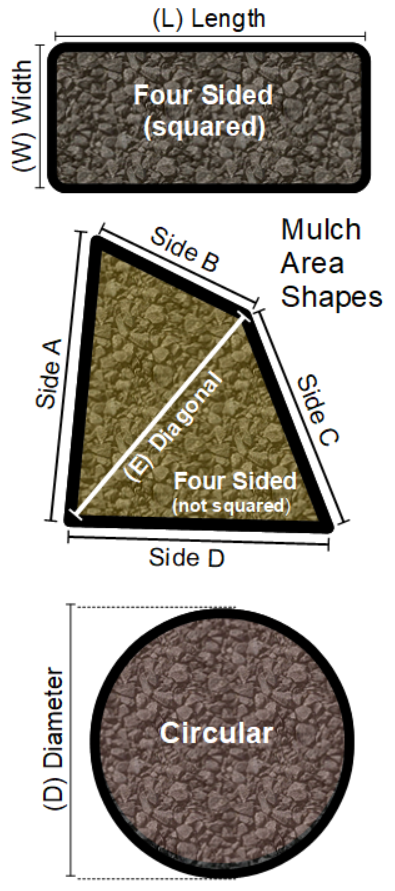
- Mulch to Cover Circular Area: Enter the diameter (D) of the circle and depth of mulch wanted, and see estimated amount of mulch needed.
- Mulch to Cover Rectangular Area: Enter the length (L) and width (W) of the area and depth of mulch wanted, and see estimated amount of mulch needed.
- Mulch to Cover Four Sided (not squared) Area: Enter the length of the four sides (a,b,c,d) and the diagonal (D) of an irregular area (see diagram) and the depth of mulch wanted, and see estimated amount of mulch needed.
- Mulch Cost Estimate: Enter the amount of mulch needed, choose a type of mulch and it will provide an estimate of the cost.
- Mulching With Straw (Irregular Area): Enter the length (L) and width (W) of the rectangular area and it will estimate the number of bales of straw needed to mulch the area with straw.
- Mulching With Straw (Area): Enter the area (acres, square feet) to see an estimate of the number of bales of straw needed to mulch the area with straw.
- Bulk vs Bag Price Comparison: Enter the bulk mulch and bag prices and volumes, and it tells you which is cheaper and by how much.
- Bulk Mulch Coverage: Estimates the area that can be covered by a volume (e.g., garden center scoop) of bulk mulch based on the number of units (bulk scoops), size of units (cubic yards) and the depth the mulch will be spread.
If mulch is not the best application, consider using Landscape Fabric and the Landscape Fabric Calculator.
Conclusion
In the long run, mulching saves time, reduces the amount of watering, reduces the weed-killer chemicals needed, and makes your garden pop! Good luck repelling the weedy invaders, and if you ignore them, well, I hope you like dandelions.